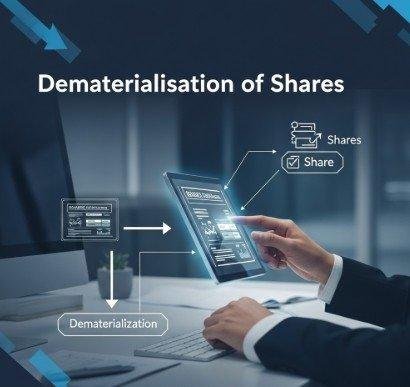
Demat of Shares
Expert assistance to convert physical shares into
dematerialized form as per regulatory requirements.
Demat of Shares refers to the process of converting physical share certificates into electronic
form held in a Demat account. As per regulatory requirements under the Companies Act, 2013 and
SEBI guidelines, certain classes of companies and shareholders are required to hold and transfer
shares only in dematerialized form to ensure transparency, security, and ease of transfer.
What is Demat of Shares?
Demat of Shares is the process of eliminating physical share certificates and converting them
into digital format through a depository system like NSDL or CDSL. The shares are credited to
the shareholder’s Demat account, making transactions faster, safer, and free from risks like
loss, theft, or damage.
Who Needs Demat of
Shares?
- Shareholders holding physical share certificates
- Private Companies (as per MCA rules for dematerialization)
- Investors planning to transfer shares
- Companies issuing securities in electronic form
- Promoters and directors holding company shares
Documents
Required
- Physical Share Certificates
- PAN Card
- Aadhaar Card / Address Proof
- Demat Account Details
- Client Master List (CML)
- Dematerialization Request Form (DRF)
- Others
Types of Demat of
Shares
01
Regular Demat Account:
- Designed for resident Indian investors
- No limit on number or value of securities held
- Requires annual maintenance charges (AMC)
- Offered by depositories like NSDL and CDSL through Depository Participants
02
Basic Service Demat Account (BSDA):
- Suitable for small investors with limited holdings
- Low or zero AMC for holdings up to ₹50,000
- Nominal AMC for holdings up to ₹2 lakhs
- Only one BSDA allowed per PAN
03
Repatriable Demat Account:
- Available for Non-Resident Indians (NRIs)
- Linked with NRE bank account
- Allows transfer of funds abroad (repatriation)
- Subject to prescribed annual limits
04
Non-Repatriable Demat Account:
- Also for NRIs with NRO bank account
- Funds cannot be transferred outside India
- Suitable for income earned within India
- Allows transfers within domestic accounts only
How to Apply for
Demat of Shares?
Dematerialization is done through a Depository Participant (DP):
Basic Steps:
- Open a Demat account with a Depository Participant (NSDL/CDSL).
- Fill Dematerialization Request Form (DRF).
- Submit physical share certificates along with DRF.
- DP forwards request to the company/registrar.
- Verification of documents and certificates.
- Shares are converted into electronic form.
- Shares are credited to Demat account.
- Confirmation received from depository.
Advantages and
Limitations
Advantages
- Eliminates risk of loss, theft, or damage of certificates.
- Enables quick and easy transfer of shares.
- Reduces paperwork and administrative burden.
- Ensures compliance with regulatory requirements.
Limitations
- Requires Demat account maintenance charges.
- Dependency on electronic systems and intermediaries.
- Initial documentation and verification required.
- Old shares may require correction before conversion.
Why Choose HIVA
Professionals?
-
Complete Demat Assistance
End-to-end support for share dematerialization.
-
Documentation Support
Proper guidance for DRF and required documents.
-
Fast Processing
Quick coordination with DP and registrar.
-
Expert Professional Guidance
Support as per latest MCA & SEBI rules.
-
Hassle-Free Process
Smooth and secure conversion of shares.