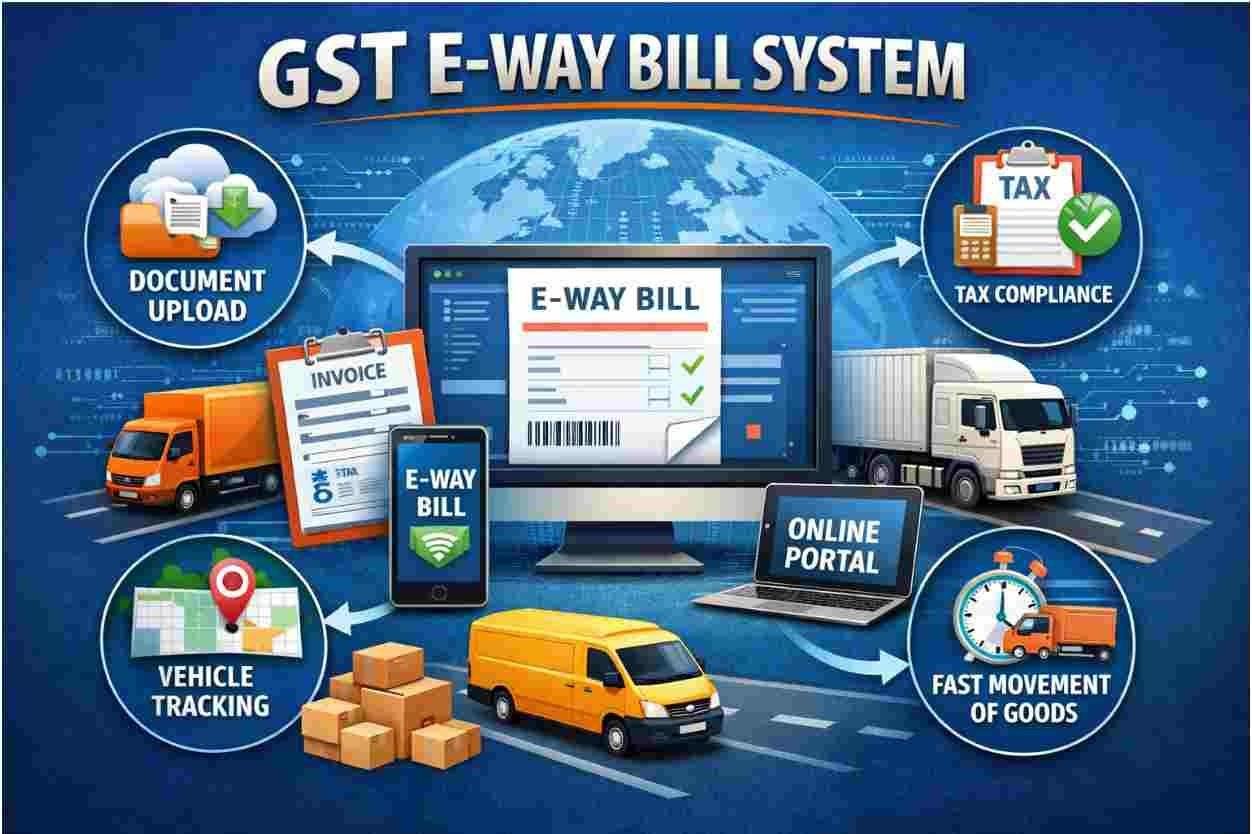
GST E-Way Preparation
Seamlessly manage goods transportation compliance under Goods and Services Tax (GST) laws for the Financial Year 2025-2026.
HIVA Professionals provides complete assistance for GST E-Way Bill generation, Part-A and Part-B preparation, bulk bill processing, validity extension, and reconciliation with GSTR-1 and GSTR-3B returns.
What is GST E-Way Preparation?
An E-Way Bill (Electronic Way Bill) is a mandatory document generated electronically under Rule 138 of the CGST Rules, 2017, for the movement of goods worth more than ₹50,000. GST E-Way Preparation involves verifying consignment invoices, generating Part-A (supplier, recipient, and tax details) and Part-B (vehicle and transport details), and issuing valid 12-digit E-Way Bill Numbers (EWB) with QR codes for smooth transit across state and national borders during Financial Year 2025-2026.
Who Needs GST E-Way Preparation?
- Businesses transporting goods worth over ₹50,000 for sales, job work, exports, or stock transfers.
- Entities carrying goods by road, rail, air, or ship where suppliers have not generated EWB.
- Unregistered businesses sending goods to registered buyers (where the recipient must generate EWB under RCM).
- Digital platforms fulfilling orders requiring interstate or intrastate movement of goods.
- Businesses transferring port-bound or customs-cleared cargo under LUT or tax payment modes.
Types of GST E-Way Operations & Forms
01
Standard EWB-01 Generation
- Single transaction E-Way bill generation capturing invoice details, HSN codes, tax amounts, and vehicle numbers.
- Generates Part-A (Item & Tax info) and Part-B (Transportation Info).
02
Bulk E-Way Bill Preparation (EWB-02)
- Ideal for high-volume manufacturers and distributors generating hundreds of invoices daily.
- Uses JSON file upload formats or ERP API integrations for instant batch creation.
03
Consolidated E-Way Bill (CEWB-01)
- Used by transporters carrying multiple consignments in a single vehicle.
- Combines multiple EWBs into a single master document for hassle-free highway checks.
04
Validity Extension & Route Updates
- Request extension of E-Way Bill validity in case of breakdown, transshipment delays, or adverse weather conditions.
- Must be updated within 8 hours before or after the expiry of the original EWB validity period.
05
Multi-Vehicle & Transshipment Update
- Update Part-B details when goods are transferred from one vehicle to another during transit.
- Prevents vehicle detention and penalties by tax authorities during road checks.
06
E-Way Bill Cancellation & Rejection
- Cancel E-Way Bills within 24 hours if goods are not transported or order is cancelled.
- Recipients can reject incorrectly generated EWBs assigned against their GSTIN within 72 hours.
Documents Required
- Tax Invoice / Bill of Supply / Delivery Challan
- Active GSTIN of Supplier & Recipient
- Transporter ID or Vehicle Registration Number
- Transport Document Number (Lorry Receipt / Railway Receipt / Airway Bill)
- Item Details (HSN Code, Quantity, Value, Tax Rates)
- E-Way Bill Portal Login Credentials
- Pin Code of Dispatch and Delivery Locations (for distance calculation)
- Others
How to Prepare & Generate GST E-Way Bill?
Basic Steps:
- Log in to the official GST E-Way Bill Portal (ewaybillgst.gov.in) using your registered GST credentials.
- Select "Generate New" under the E-Waybill menu option.
- Enter Transaction Type (Outward / Inward), Sub-Type (Supply, Export, Job Work, SKD/CKD, Line Sales, etc.), and Document Type (Invoice, Credit Note, Delivery Challan).
- Fill in Supplier (From) and Consignee (To) details, including GSTIN, Address, and PIN Codes.
- Input Item Details, HSN Code, Taxable Value, CGST, SGST, IGST, and Cess applicable for Financial Year 2025-2026.
- Provide Transport details (Part-B): Mode of Transport (Road, Rail, Air, Ship), Distance in KM, Transporter Name, Transporter ID, or Vehicle Number.
- Review details carefully and submit to generate the 12-digit E-Way Bill Number (EWB) with embedded QR code.
- Print or share the generated E-Way Bill with the vehicle driver / transporter to accompany the consignment.
Advantages and Limitations
Advantages
- Ensures smooth highway movement of goods without unnecessary checkpost delays.
- Reduces paper documentation through digital QR code verification.
- Integrates directly with GST returns, minimizing manual filing errors.
- Prevents heavy penalties and vehicle detention under GST Section 129.
Limitations
- Strict validity timelines based on distance (e.g., 200 km per day for normal cargo).
- Mandatory Part-B vehicle update required before vehicle departure.
- E-Way bill generation gets blocked if monthly GST returns are pending.
- Cancellation allowed only within 24 hours of generation.
Why Choose HIVA Professionals?
-
Dedicated Logistics & GST Experts
Experienced CA & GST professionals dedicated to error-free E-Way Bill preparation.
-
24/7 Express & Extension Support
Round-the-clock assistance for urgent Part-B updates and validity extensions.
-
Seamless ERP & e-Invoice Integration
Automated setup connecting your billing system directly to the E-Way Bill Portal.
-
Notice & Seizure Protection
Proactive compliance verification to eliminate transit detention risks for FY 2025-2026.
-
End-to-End GST Ecosystem
Complete multi-service support spanning registration, filing, audits, LUT, and advisory.